
Swimmer’s Itch, Faulty Septics & Invasive Species
By Bill O'Brien | July 22, 2026
From swimmer’s itch to faulty septic systems to invasive species, Rob Karner has tackled all sorts environmental challenges over the years in Leelanau County’s Glen Lake and Crystal River watershed.
Karner will step back later this year from his role as staff biologist at the Glen Lake Association, leaving a five-decade legacy as a teacher and biologist leading landmark initiatives in protecting and preserving one of Michigan’s best-known inland waterways.
“He is a larger than life character,” Glen Lake Association President Kate Gille says. “His leadership in that role has really made an impact for lake associations across Michigan.”
Karner, 73, was born and raised in Dundee and earned a degree in zoology from Michigan State University, along with his teaching certificate. He first taught at Lansing Everett High School – where basketball legend Magic Johnson was among his students. He learned of a biology teacher opening at the Leelanau School – the small, private boarding school in Glen Arbor – where he was hired in the spring of 1977.
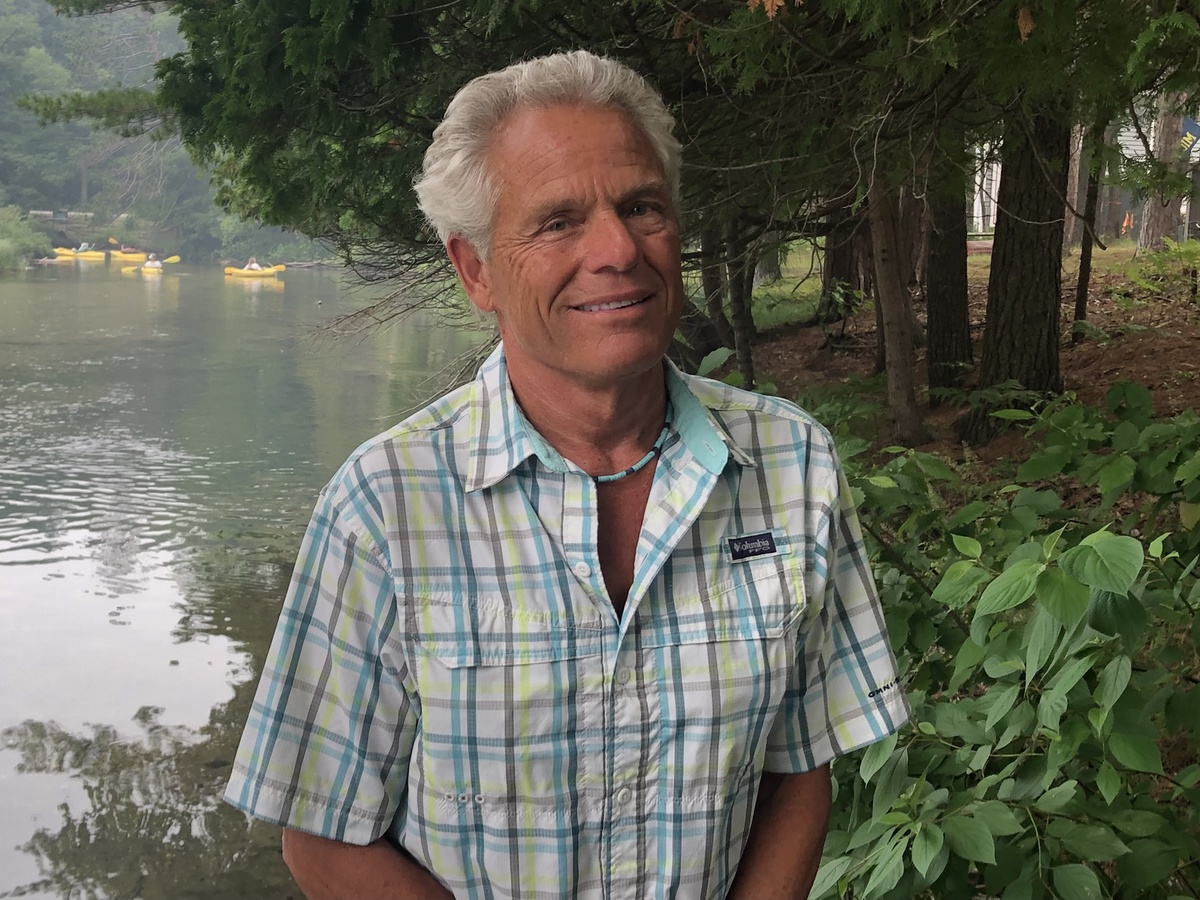
Karner (pictured at his home on the Crystal River) soon studied for a masters degree for three summers at the University of Michigan Biological Station on Douglas Lake near Pellston, where he learned from and worked with some of the top researchers and scientists in North America.
“I’m rubbing elbows with the best of the best of best,” Karner says. “Is that exciting? Is that rewarding? Is that productive? The answer is yes.”
Much of Karner’s early work as a consultant for the lake association revolved around swimmer’s itch, the allergic skin reaction caused by microscopic parasites. In the 1980s, the lake association used copper sulfate in an attempt to kill the lake bottom snails that hosted the parasite.
But Karner says the efforts weren't particularly effective, and he was also concerned about the agent’s detrimental impact on wildlife and the long-term water quality. He eventually persuaded the association to end the treatments and try a new remedy: removing merganser ducks from the lake, as their waste was tied to infecting the snails with the itch parasite.
Karner says the association spent thousands of volunteer hours and upwards of $30,000 annually to relocate the ducks. But swimmer’s itch remained a problem, as researchers learned in a five-lake study that mallard ducks and geese were also tied to the parasite.
Today, swimmer’s itch prevention efforts are focused on educating swimmers about where and when to swim to avoid serious outbreaks.
“I’m really proud that one of my accomplishments is to say I’ve been part of an educational thrust to say to swimmers ‘if you’re careful and understand how swimmer’s itch works, you can swim in Glen Lake and not get itch’,” Karner says. “You have to think before you swim, and you have to be careful about where you swim and when you swim.”
The shift away from costly swimmer’s itch remedies left more resources for the association to tackle other water quality issues, including the impact of waterfront septic systems on lake water.
In 2018, Karner teamed up with long-time colleague Ron Reimink of Leelanau's own Freshwater Solutions on a septic study involving both Little and Big Glen Lakes and the county’s Lime Lake and Little Traverse Lake.
“It lasted long enough to collect enough water samples to suggest that there was a myth out there that most of septic systems in our watershed were not polluting and that they had no influence on the water quality,” Karner says. “Sure enough, we were getting septic influences… 50-some sample sites out of 200 were showing this bacterium that is only found in the digestive system of the human gut track.”
Karner says their research “finally moved the needle” to convince county officials in 2022 to pass a county ordinance requiring septic inspections during property transfers. It was similar to an ordinance previously implemented in neighboring Benzie County.
Some of Karner’s other initiatives include convincing the National Park Service to implement a “no mow zone” at the Little Glen Picnic Area across from the Sleeping Dune Climb. It was a beach prone to multiple E. coli closures because of large geese flocks that congregated there.
“It turned into being a natural buffer – or a greenbelt – where 30 feet from the water’s edge the park quit mowing,” Karner says. “It naturally populated its own native plant base that was there from the beginning. So it cleared up the E. coli problem and it reduced the work on the part of the national park.”
Those practices have since spread to numerous private properties on Glen Lake.
“When we think about education, one of the best things we can tell people is to keep your shoreline natural,” Karner says. “Let the native plants with their deep roots be the filter for the lake water.”
Karner retired from teaching at the Leelanau School in 2014. While there he led students on hundreds of field trips to do research in the nearby watershed and the national lakeshore. He also led numerous research trips across the U.S. and Europe to study science and biology.
That same year, he was also hired as the Glen Lake Association’s staff biologist, which Gille says was the first such hire for a lake association in Michigan.
Two years ago Karner and Reimink teamed up with staff at the Lake Leelanau Lake Association and the Grand Traverse Band of Ottawa and Chippewa Indians to help curtail the spread of Eurasian watermilfoil in Glen Lake. They utilized much of the data gathered in Lake Leelanau and by the band, utilizing burlap covers to stop the invasive watermilfoil from spreading in Glen Lake.
“He’s a great steward of the planet, and the Glen Lake watershed,” Reimink says. “I’ve learned as much from him as he says he’s learned from me.”
Because of Karner’s positive impact on the lake’s health, Gille says the lake association board decided to make the position full-time. It’s launching a national search for a watershed scientist and program manager, a position it hopes to fill by early 2027.
Karner said he’ll continue to work with the association during the transition, but that his retirement will give he and his wife Barb more time to travel and spend time with their two adult sons and their families. He also wants to devote more time to his passion of long-distance swimming.
“I’d guess I’d rather wear out than rot out,” he says.
The Glen Lake Association will host a public reception for Karner following its annual meeting this Saturday, July 25, from 9-10am at the Glen Lake Community Church.


The Latest Leelanau County Blotter & 911 Call Report
The Leelanau Ticker is back with a look at the most alarming, offbeat, or otherwise newsworthy calls …
Read More >>Swimmer’s Itch, Faulty Septics & Invasive Species
From swimmer’s itch to faulty septic systems to invasive species, Rob Karner has tackled all sorts environmental …
Read More >>

New Leland Organization Needs Money, People To Keep Traditions Alive
Leland’s beloved community traditions and beautification operations will need financial support now and well into the future. …
Read More >>Northport Dam Intact And Functional After Inspection
An inspection has revealed that Northport's Mill Pond dam is intact and operational without major structural issues …
Read More >>