
Grain: The Key To Saving Northern Michigan Agriculture?
By Craig Manning | May 18, 2026
Nic Welty wants to help local farmers diversify – and maybe build up an industry of premium northern Michigan grain products in the process.
Late last month, the Suttons Bay-based 9 Bean Rows – which Welty co-owns along with his wife Jen – landed a $163,000 grant from the Michigan Department of Agriculture and Rural Development (MDARD) and its Resilient Food Systems Infrastructure program “to launch a regional milling facility to support the grain industry.” Those funds follow a separate $40,000 grant 9 Bean Rows got last year from MDARD’s Underserved, Value-Added, and Regional Food System grant program, also earmarked for “building a small-scale milling facility.”
Welty says the grants will make it possible for the grain mill project to move forward this year, realizing one of his longest-held dreams for 9 Bean Rows.
“It’s something we've been working on for 10 or more years now. It's just been a long, ongoing process to try to see if we can get this locally resilient grain system put back together again,” Welty explains. “We had had a neighboring farmer growing grain for us 10 or so years ago, and another guy that tried to start a milling operation. We tried to coordinate with the two of them so we could start supplying other accounts, but the business model just never worked. They both went out of business.”
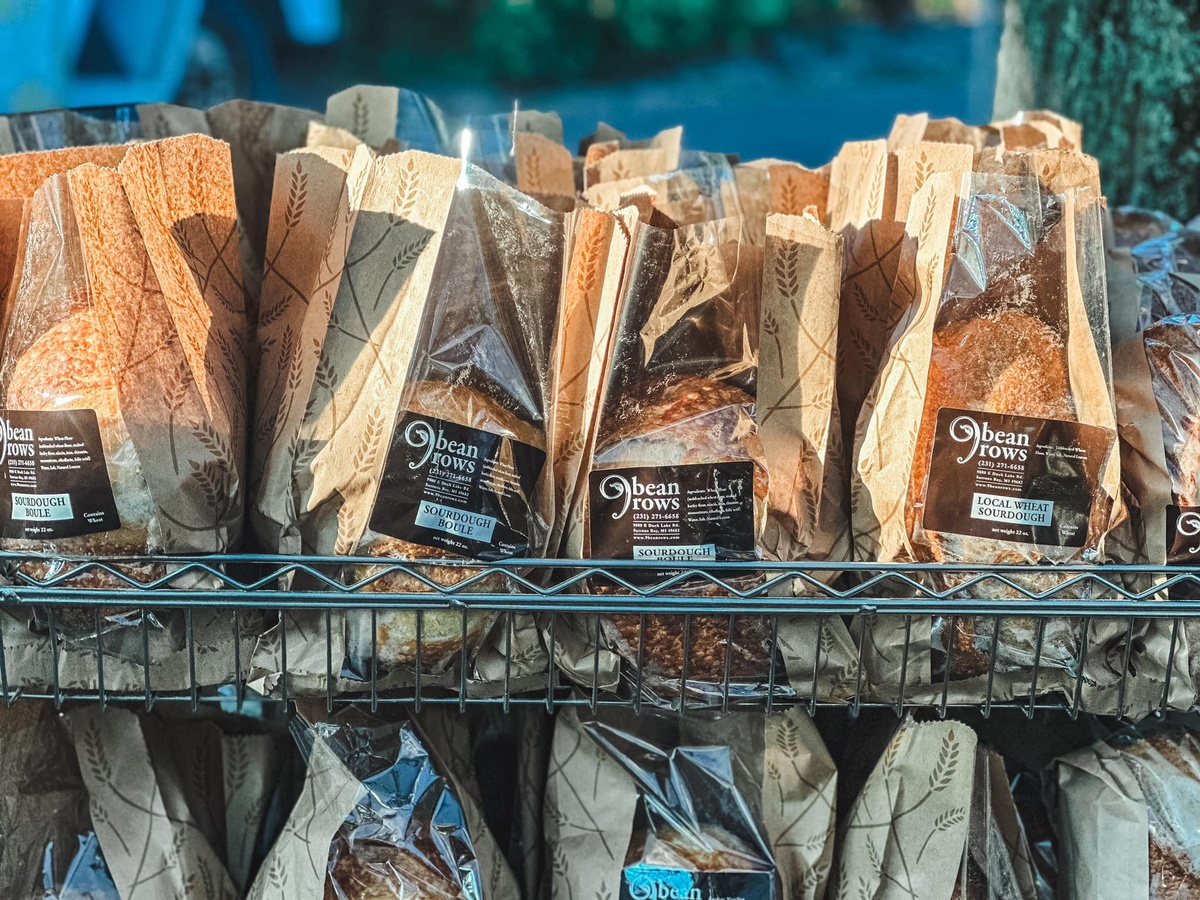
9 Bean Rows runs a full bakery, a café, and (in the summertime) a pizza restaurant, which means the farm always has plenty of use for high-quality grain – ideally locally-grown and locally-sourced. Due to space limitations, though, the farm isn’t able to grow enough grain to meet its own needs – let alone supply to other local businesses.
“Our farm is quite small,” Welty tells The Ticker. “We rent a little bit of land from the neighbors, where we can grow the sweet corn and the pumpkins. Once, I did an acre of wheat, and we have some rye. But we don't really have the equipment for grain, and we just don’t have the space. You really need tens of acres – if not hundreds of acres – to make a grain operation worthwhile. So, this is sort of outside of the scale of our farm, but well within the capacity of a lot of other farmers.”
Welty’s mentality is “If you build it, they will come” – with the “it” being a milling operation that would make it easy for local farmers to turn their grain into “something they can sell as a value-add product, whether it’s bread, or pasta, or flour.” With such an option available right here in northern Michigan – and actually run by fellow farmers – Welty thinks a lot of local agriculture players might consider diversifying into grain.
“What we want is something that's a more affordable and profitable crop for farmers to pursue with their farmland around here,” Welty says. “Most of the farmland in Leelanau County is struggling at this point because of cherry production issues, cherry market issues, pricing issues, all those kinds of things. We thought maybe grain was a good opportunity, because there's a pretty big demand for it. If you follow the artisan baking world, people get pretty excited about this kind of thing.”
While Welty is excited about the prospect of having a local supply chain of high-quality grain products, he cautions that grain won’t be the silver bullet to solve all of the local agriculture industry’s problems.
“Just like any farm opportunity, we have to figure out the scale of how much grain can be brought in, milled, and turned into product,” Welty says. “With hops, there was this big boom, and then we learned that there’s basically a marketplace for about 200 acres of hops [in Michigan]. How big is the total market size for grain? I don’t necessarily think it's thousands of acres, but it's certainly way more than just a few acres. I think there’s an opportunity here for people who have underutilized farmland, and maybe we'll learn the marketplace is even bigger than we think once we start getting into it.”
Last year’s MDARD grant allowed 9 Bean Rows to “purchase the initial equipment” for the mill and “start getting this all set up and going,” Welty says; the farm officially started milling its own grain late last year. The second MDARD grant from last month provides additional funds for the “infrastructure” around the project, including a new storage barn to keep bulk quantities of grain in a cool, dry place, as well as a new septic field and new utilities to serve the facility.
If all goes well, Welty hopes to have the full operation running by the end of the year.
“We’re moving as quickly as we can to get all this put together,” he says. “It's definitely not a small project. I've got a handful of different engineers we've had to get involved to account for all the different safety parameters and things like that. But we've got what I think is a pretty good team of experts, and me and the crew will build it all this year.”
Comment

Grain: The Key To Saving Northern Michigan Agriculture?
Nic Welty wants to help local farmers diversify – and maybe build up an industry of premium …
Read More >>Property Watch: Unforgettable Lakefront Estate
This Leelanau County listing offers a home that's "more than a residence - it's an experience" for …
Read More >>

Workin' on Woolsey: Iconic Structure Getting Repairs and Upgrades
Efforts are underway to rehabilitate one of Leelanau County’s most unique and storied buildings.
The Save Woolsey …
Read More >>Youth For Christ Resuming Operations At 110 North Lake Street, Despite Permit Denial
The Leland LightHouse has reopened its youth Christian clubhouse at 110 North Lake Street, despite a decision …
Read More >>