
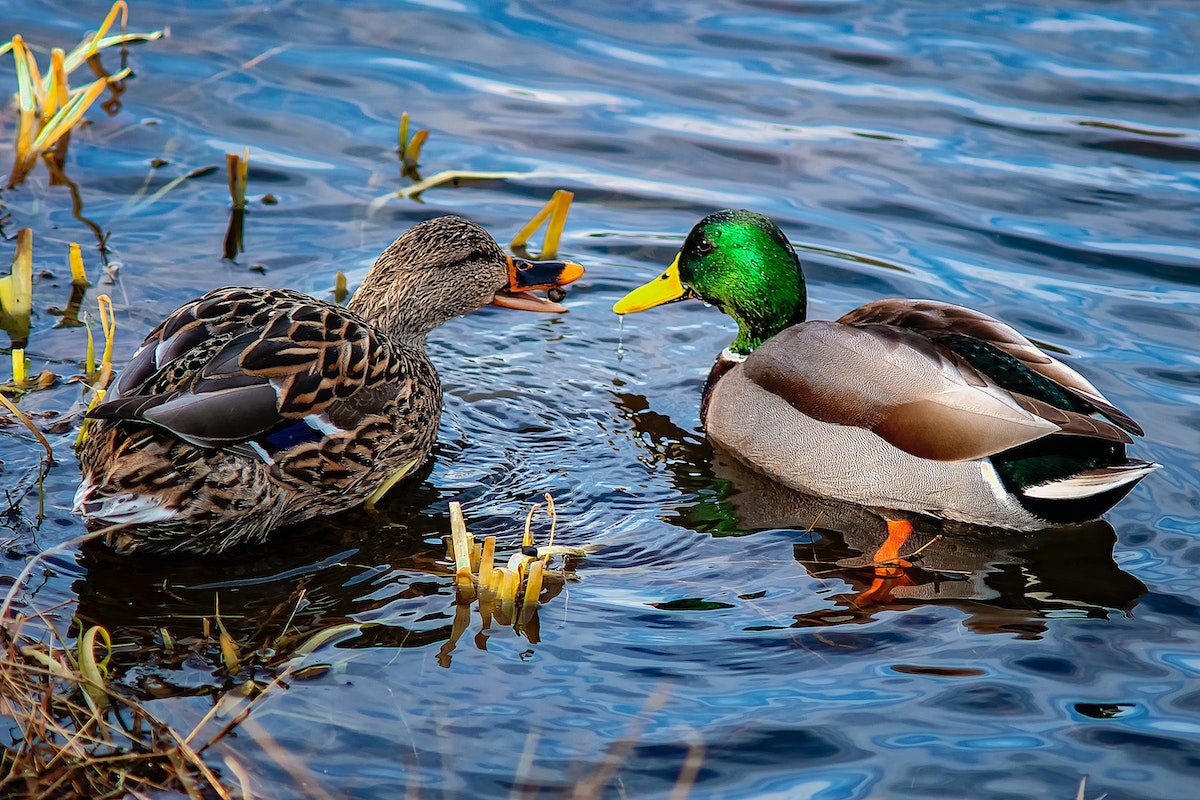
Michigan’s Mallard Numbers On The Decline -- But Why?
By Victor Skinner | Oct. 19, 2022
Annual aerial surveys conducted by the Michigan Department of Natural Resources show Michigan mallard numbers have declined from about 523,000 in 1998 to an estimated 140,000 in 2022, and biologists are unsure what’s driving the trend.
Local mallards are not exactly considered exotic in northwest Michigan, so it’s no surprise those who track area bird populations haven’t noticed a significant decline.
Says Nate Crane, coordinator for the Lake Leelanau Christmas Bird Count the last five years, “Serious birders have a tendency to overlook mallards.” The variability in seasonal ice cover and other factors that impact the annual bird count, along with the relative abundance of mallards in northwest Michigan, has meant a decades-long decline in mallard numbers has largely flown under the radar.
Historically, mallards in Great Lakes states — including Michigan, Wisconsin and Minnesota — followed trends similar to the midcontinent population until the mid-2000s.
That’s when something puzzling started to happen: Great Lakes mallard abundance continued a downward trend while populations increased in other areas.
Barbara Avers, Michigan DNR’s waterfowl and wetland specialist, says biologists initially believed the divergence was related to low Great Lakes water levels providing less habitat, but numbers continued to decline after water levels recovered around 2007.
Michigan State University researchers also examined hunting regulations, harvest rates and hunter participation as possible factors in recent years, but concluded “it’s not harvest that’s driving the population down,” Avers says.
“What we can be very confident in is that there’s definitely been this declining trend, especially in the last 30 years,” she says. “Our estimates are below what we’ve seen for the long-term average.”
Now, a new study is underway to explore other possible factors, including the influence of mallards released from game farms, and an apparent shift of breeding distributions toward urban wetlands that are not typically covered in aerial surveys.
“It’s been really difficult to figure out what the releases have been in Michigan of these game farm mallards,” Avers says. “We know some are being released, we just don’t know the scale of it.”
Ben Luukkonen is leading the effort to better understand the impact. The MSU PhD student is coordinating with researchers in Michigan, Wisconsin, Indiana and Ohio to take blood samples from hundreds of hen mallards and fit the birds with GPS transmitters to track their movements.
“Simply put, the main goal of the research is to determine what factors are limiting abundance of Great Lakes mallards,” he says, adding that there’s several theories the research will help to explore.
One theory is “the mallard breeding distribution is shifting northward due to climate change,” he says. “We’re also looking at this issue of genotype.”
Farm released mallards may not fly as far as wild birds, could be more likely to nest in urban areas, and may not reproduce at the same rate, he says.
“Those mallards have been released for about 100 years now,” Luukkonen says.
Researchers in the five states began capturing hen mallards last spring to take blood samples and fit the transmitters, which relay location data to Luukkonen once per day, if they receive service.
“The transmitters themselves are essentially like a small backpack. There’s a solar panel on the top of the transmitter” to recharge the devices, he says. “I’m able to monitor pretty much what these birds are doing on a daily basis.”
Researchers fitted just under 200 hens with the devices last year, and another 241 this year. A total of 436 transmitters are now sending back information, and researchers are planning to add more next year.
“We expect to have marked over 500 birds with transmitters” by the end of fieldwork in 2023, Luukkonen says.
The data will eventually be incorporated into a population model with abundance estimates from aerial surveys and banding data. So far, the effort has produced more than 1.7 million GPS locations, as well as some information on genetics from birds sampled last year: Of the roughly 200 birds sampled across five states in 2021, 56 percent were wild birds compared to 44 percent that were hybrids, or a cross between wild and game farm mallards.
“That’s a higher proportion of hybrids than what I expected,” Luukkonen says. “Some of these hybrids, especially those closer on the domestic side, are just not behaving like a wild bird does.”
The more domestic birds do not appear to move as much, and seem to utilize more urban wetlands, he says. “These hybrids are actively selecting for urban areas,” Luukkonen says. “It kind of makes sense … they’re probably not adapted to avoid predators and not adapted to eat wild seeds.”
It’s also possible aerial surveys are not counting the urbanized birds, as the surveys are typically conducted over traditional wetland habitats.
“The potential is good we could be undercounting,” Luukkonen says.
Luukkonen credits the progress of the research so far to the strong working relationship between researchers at MSU and partners in other states, which include Ducks Unlimited, the U.S. Fish and Wildlife Service, the Illinois Natural History Survey, the Indiana DNR, Franklin College, the Wisconsin DNR, and the Winous Point Marsh Conservancy, run by a private hunting club in Ohio.
University of Texas at El Paso’s Phillip Lavretsky is analyzing the genetics.
He’s also encouraging Michigan hunters to contribute, as well. “One of the things hunters can do to help us is to just report their bands,” he says. “It’s a huge source of information.”
Luukkonen plans to present the findings of the research when he defends his dissertation in the summer of 2024. In the meantime, Crane says he’ll be watching how the decline in mallards might benefit species that compete and mate with the birds, specifically the eastern black duck. Mallards have largely displaced the native black duck over the last 100 years, reducing the population by about 90 percent, he says.
“In a way, from a historical sense, it could be a good thing,” Crane says.
Comment

Suttons Bay Sports Boosters Selling Gym Floor
Suttons Bay Sports Boosters will sell pieces of the old middle school gym.
"For generations, Suttons Bay's …
Read More >>LIFT Announces 2026 Summer Programming
Leelanau Investing for Teens (LIFT) has announced its summer programming plans for the summer of 2026. The …
Read More >>

Summer's Almost Here: Your Guide To Leelanau County's Seasonal Reopenings
Memorial Day weekend is just two weeks away, which means many of Leelanau County’s seasonal establishments are …
Read More >>Here's Why Youth For Christ Is Back On The Agenda For Tonight's Leland Township Planning Commission Meeting
Youth for Christ is back on the planning commission agenda in Leland Township this week – albeit, …
Read More >>